

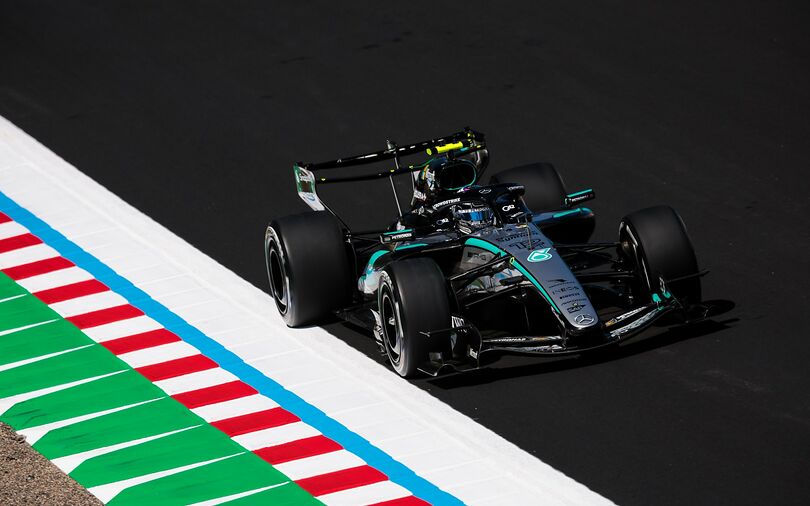
Kimi Antonelli delivered a statement win at Suzuka, claiming his second Formula 1 victory and becoming the first teenager in history to lead the World Championship, now sitting on 72 points after three rounds.
The Mercedes driver overcame a poor start, a charging Oscar Piastri, and a tightly packed strategic battle — but ultimately mastered the race through pace, precision and perfect timing.
The opening seconds once again reshuffled the order. Antonelli bogged down, while Oscar Piastri and Charles Leclerc launched superbly, with the McLaren driver immediately taking the lead. Piastri controlled the early phase comfortably, maintaining the advantage until his scheduled stop.
But the race turned on lap 22, when Ollie Bearman crashed heavily at Spoon Curve. The Safety Car that followed arrived just after Piastri had pitted — and just before Antonelli needed to. The Italian seized the opportunity, stopping under neutralisation and emerging in the net lead.
From there, he was untouchable. On the restart, Antonelli immediately pulled clear, demonstrating the strongest race pace of the field and never allowing Piastri or Leclerc a realistic chance to challenge.
Behind him, the fight for the podium was fierce. Piastri eventually secured second, while Leclerc — after a brilliant wheel‑to‑wheel exchange with George Russell — claimed third. Russell finished fourth, with Lewis Hamilton fading to sixth after initially benefitting from the same Safety Car timing as Antonelli.
Tyre Performance: Hard Compound Dominates the Race
The strategic landscape was straightforward: 19 of 20 drivers started on the C2 Medium, with only Valtteri Bottas choosing the C1 Hard. The race evolved into a classic one‑stop, and the tyre data from Suzuka paints a clear picture of how teams approached the afternoon.
Lando Norris completed the longest stint of the race on the C1 Hard, running 37 laps on the compound. His pace remained consistent deep into the stint, and his tyre life contributed to McLaren’s late‑race competitiveness.
The Hard tyre was also the most heavily used compound overall, accumulating 609 laps, representing 55% of all laps completed during the Grand Prix.
On the C2 Medium, Valtteri Bottas logged the longest run at 33 laps, a number that reflects Cadillac’s attempt to offset their lack of raw pace with alternative strategy. Across the grid, the Medium totalled 493 laps, or 45% of the race distance.
The C3 Soft was almost entirely unused in race conditions. Only four laps were completed on the Soft — all by Alex Albon — representing 0% of meaningful race mileage. His single‑lap Soft run produced the fastest lap of the day, but it was clearly a data‑gathering exercise rather than a strategic choice.
These numbers align with Pirelli’s post‑race analysis. Motorsport Director Dario Marrafuschi explained: “The quickest strategy on paper was essentially the one adopted by all the drivers in the race, with Valtteri Bottas the only driver to do something different.
“No team evidently considered it worthwhile to take a risk on the Soft compound, either at the start or in the final stages, despite it remaining a viable option thanks to the low degradation recorded in the preceding days.”
He added that Albon’s Soft‑tyre run was not strategic: “Albon’s use of the C3 was clearly not driven by strategic considerations, given the high number of pit lane visits he made. During the Grand Prix, the compounds did not restrict the cars’ race pace.”
Marrafuschi also confirmed the decisive role of the Safety Car: “The safety car triggered by Bearman’s off-track moment certainly benefited those who had not attempted the undercut, including race winner Kimi Antonelli. Without the neutralisation, we still believe that the pit stop would have taken place in the laps immediately thereafter.”
And looking ahead: “Pirelli’s Japanese trip will not end today, as on Tuesday and Wednesday we have scheduled two days of testing at Suzuka for the development of next season’s dry-weather tyres. Assisting us on track, with one car each, will be the Red Bull and Racing Bulls teams.”
