

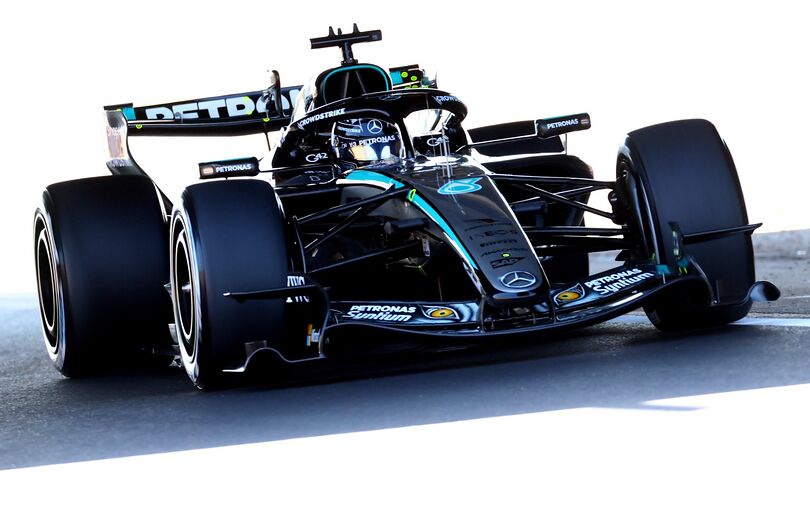
Mercedes entered the Japanese Grand Prix as the clear favourite after dominating qualifying, yet both Andrea Kimi Antonelli and George Russell immediately complicated their afternoon with sluggish starts.
What followed, however, was a demonstration of why Mercedes currently sits at the top of Formula 1’s competitive hierarchy: Antonelli recovered, controlled the race after the Safety Car, and delivered a performance that the race‑pace data confirms was the most complete of the season so far.
A Poor Start, a Perfect Reset
Antonelli’s slow getaway allowed Oscar Piastri and Charles Leclerc to surge ahead, with the McLaren driver controlling the early laps. But the turning point came when Ollie Bearman crashed at Spoon Curve, triggering a Safety Car.
Because Antonelli had not yet pitted, the neutralisation allowed him to stop without losing track position. Once the race restarted, the numbers show that he immediately established a pace advantage no one else could match.
Across the full race distance, Antonelli produced a mean lap time of 93.87 seconds, the fastest of the entire field. Piastri, who finished second, averaged 94.11 seconds, meaning Antonelli was 0.24 seconds per lap quicker than the McLaren.
Russell’s mean lap time of 94.16 seconds placed him a further 0.05 seconds behind Piastri, while Leclerc’s 94.20‑second average meant the top four were separated by just 0.33 seconds. This extremely tight spread is exactly why the race‑pace chart highlights that three teams were operating within roughly three‑tenths of a second of each other.
Mercedes, McLaren and Ferrari: A Battle Measured in Tenths
The team‑performance ranking reinforces this picture. Mercedes set the reference pace, while McLaren trailed by +0.24 seconds and Ferrari by +0.29 seconds on average. These margins explain why Piastri could stay close, why Leclerc could fight Russell, and why neither could meaningfully threaten Antonelli once he was in clean air.
Russell’s underlying pace — just 0.29 seconds slower than Antonelli — shows that Mercedes had the fastest package overall, but his compromised start and time spent in traffic prevented him from converting that pace into a podium.
The Midfield: Alpine Rise, Red Bull Struggle
The midfield order was equally revealing. Alpine emerged as the fourth‑fastest team with an average deficit of +0.97 seconds, supported by Pierre Gasly’s mean lap time of 94.85 seconds. Red Bull, surprisingly, ranked only fifth with a team deficit of +1.59 seconds, reflected in Max Verstappen’s 95.84‑second average — nearly two full seconds per lap slower than Antonelli.
Haas and Audi were tied at +1.74 seconds, which aligns with Nico Hülkenberg’s 95.58‑second mean and Gabriel Bortoleto’s 95.82‑second average. Racing Bulls followed at +2.13 seconds, with Liam Lawson’s 95.62‑second pace placing him in the thick of that group.
Williams, meanwhile, struggled significantly, operating at +2.13 seconds, which matches Alex Albon’s 96.31‑second average. At the back, Cadillac and Aston Martin both recorded deficits of +3.99 seconds, with Valtteri Bottas and Fernando Alonso each averaging 97.87 seconds.
The gap from Antonelli’s 93.87 seconds to the slowest cars at 97.87 seconds amounted to a full four seconds per lap, illustrating the enormous competitive spread across the grid.

Tyre Strategy: Hard Tyre Dominance Shapes the Race
The tyre‑usage data from Suzuka explains why the race unfolded with such strategic predictability. Lando Norris completed the longest stint of the afternoon by running 37 laps on the C1 Hard compound, demonstrating its durability.
Across the field, the Hard tyre accounted for 609 laps, representing 55% of all race mileage. The C2 Medium was used for 493 laps, or 45% of the total.
The C3 Soft, by contrast, was almost entirely absent from the race, with only four laps completed on it — all by Alex Albon — amounting to 0% of meaningful race usage.
